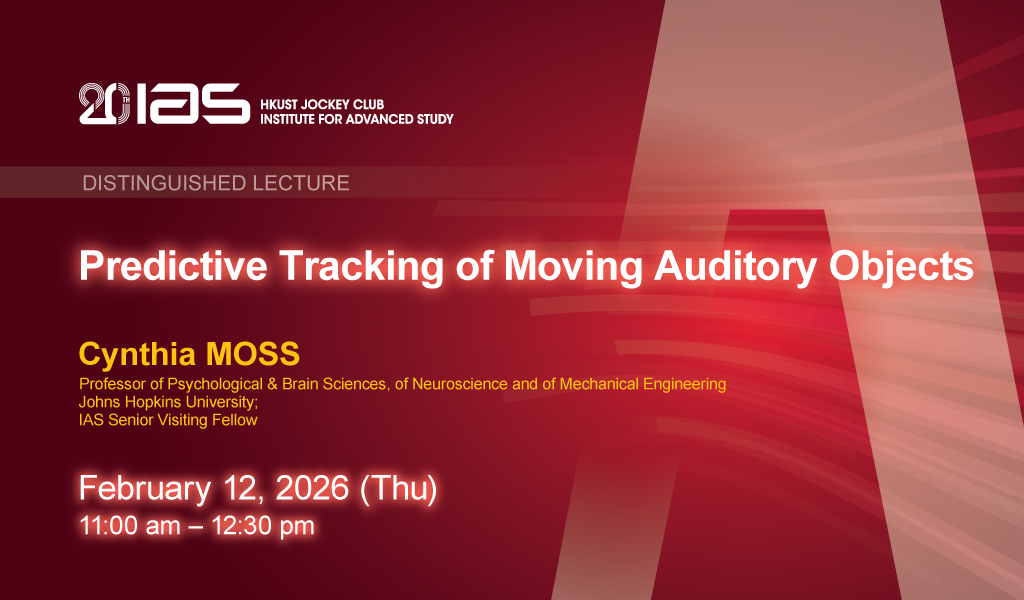
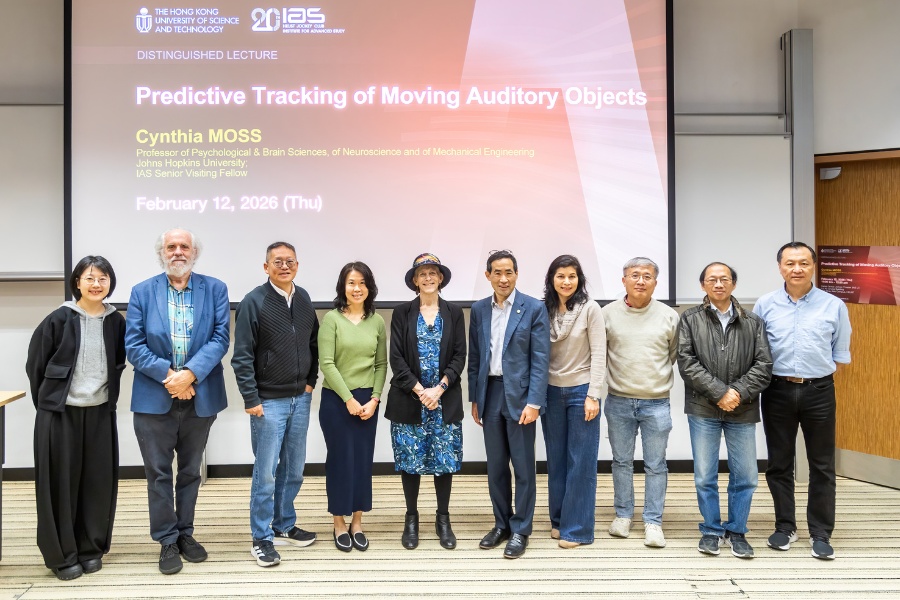
Predictive Tracking of Moving Auditory Objects




Abstract
Sensory-guided behaviors, such as target tracking, require the integration of stimulus information across space and time to guide adaptive movements. Most experimental work on target tracking has focused on vision-dominant species, and far less is known about the use of auditory information to localize and intercept moving objects. Echolocating bats provide a powerful research model to address this gap, because they actively generate the acoustic signals that guide their own behavior, and they dynamically modify these signals according to task demands and attentional state.
The speaker and her research team's work demonstrates that bats accumulate acoustic information over time to build internal predictive models of target motion. When targets become temporarily occluded—such as when prey moves behind obstacles—bats continue target tracking, using internal representations of object motion. When predictions are violated by sudden changes in trajectory, bats rapidly adjust echolocation call rate to update stimulus information and maintain successful tracking. These findings reveal fundamental principles of adaptive sensorimotor control, predictive tracking, and spatial attention that operate similarly in other mammalian systems. Beyond basic neuroscience, observations from their research can inform bioinspired navigation technologies and the development of smart assistive devices for individuals with sensory impairments, ultimately contributing to improved rehabilitation strategies and human–machine interaction in complex real-world environments.
About the Speaker
Prof. Cynthia Moss obtained her BS in Psychology with honors in Zoology from the University of Massachusetts, Amherst in 1979 and PhD in Experimental Psychology from Brown University in 1986. She was a Postdoctoral Fellow at the University of Tübingen (1985-1987) and a Research Fellow at Brown University (1987-1989) before accepting a faculty appointment at Harvard University, beginning in 1989. At Harvard, she received the Phi Beta Kappa Teaching Award (1992) and was named the Morris Kahn Associate Professor (1994). In 1995, she moved to the University of Maryland, where she was a Professor in the Department of Psychology and the Institute for Systems Research until 2014. Then she joined Johns Hopkins University and is currently a Professor of Psychological and Brain Sciences, with joint appointments in Neuroscience and Mechanical Engineering.
Prof. Moss’ research combines behavioral, neurobiological and computational studies to investigate scene perception, spatial attention, navigation and memory. She and her lab members have established methods to collect multi-channel wireless neural recordings from free-flying bats, which allow for the study of brain systems in animals engaged in natural behaviors. She has edited two books, Neuroethological Studies of Cognitive And Perceptual Processes (1996) and Echolocation in Bats and Dolphins (2002) and served as an Associate Editor of Behavioral Neuroscience, the Journal of the Acoustical Society of America, the Journal of the Acoustical Society of America Express Letters and the Proceedings of the Royal Society, B.
Prof. Moss was elected as a Fellow of the Acoustical Society of America in 2001, the American Association for the Advancement of Science in 2012, and the International Society for Neuroethology in 2018. She is also a member of the Society for Neuroscience and the Association for Research in Otolaryngology. Her recent awards include the William and Christine Hartmann Prize in Auditory Neuroscience (2017), the James McKeen Cattell Fellow Award (2018) and the Alexander von Humboldt Research Prize (2019).
For Attendees' Attention
Seating is on a first come, first served basis.