Quest for KL→𝜋0ννˉ


Abstract
The KL→𝜋0ννˉ decay is one of the most sensitive probes of physics beyond the Standard Model. Since this decay is highly suppressed and theoretically clean within the Standard Model, any deviation of the measured branching ratio from the predicted value of 3 x 10-11 would constitute clear evidence for new physics.
Experimentally, however, this decay mode is extremely challenging. The parent neutral KL cannot be directly observed, and the only visible particles in the final state are the two photons from the 𝜋0 decay. Moreover, numerous background processes can mimic the signal. Over the years, many experiments have been proposed, employing a variety of experimental strategies. Currently, the J-PARC KOTO experiment sets the most stringent upper limit on the branching ratio.
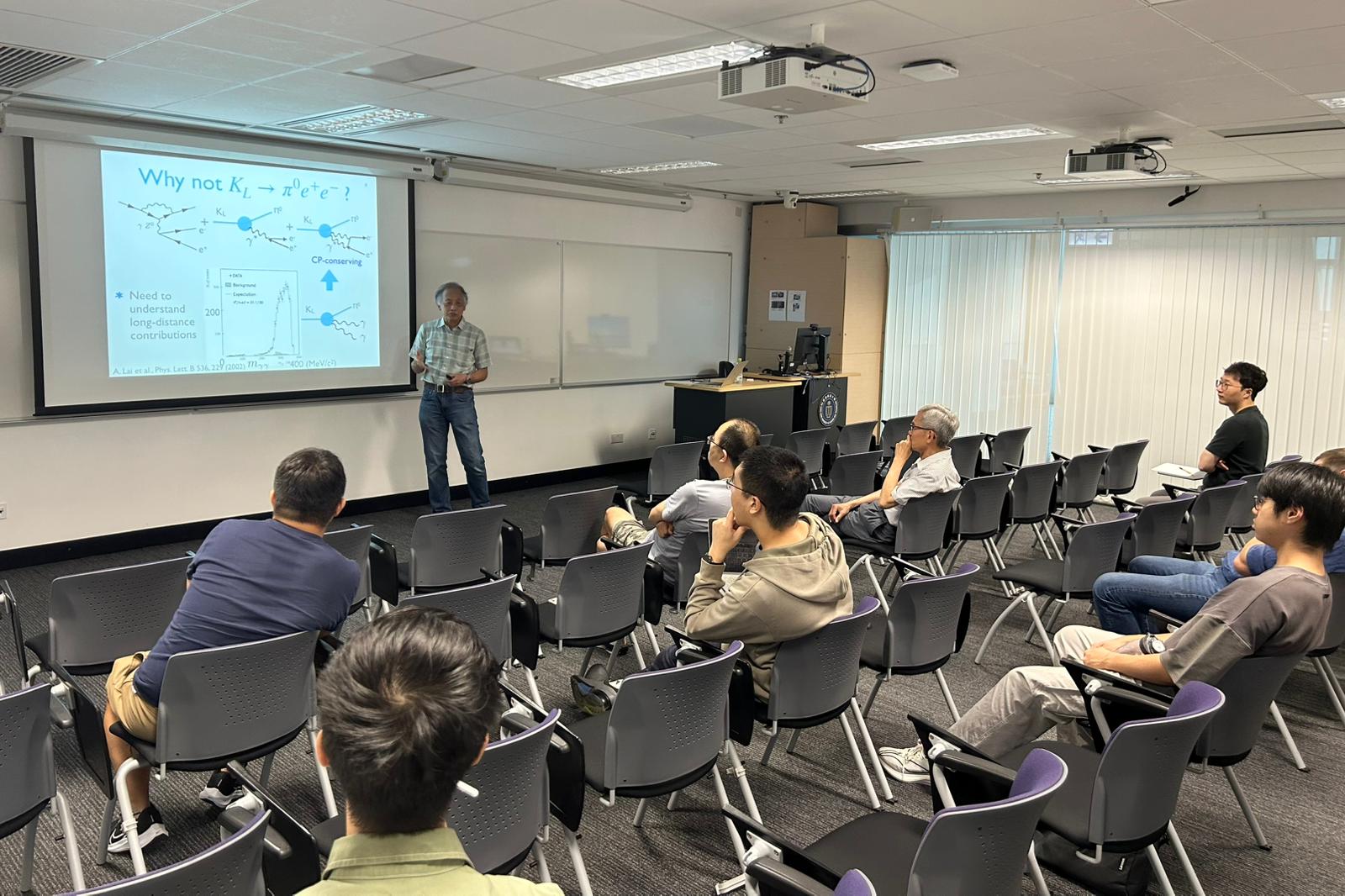
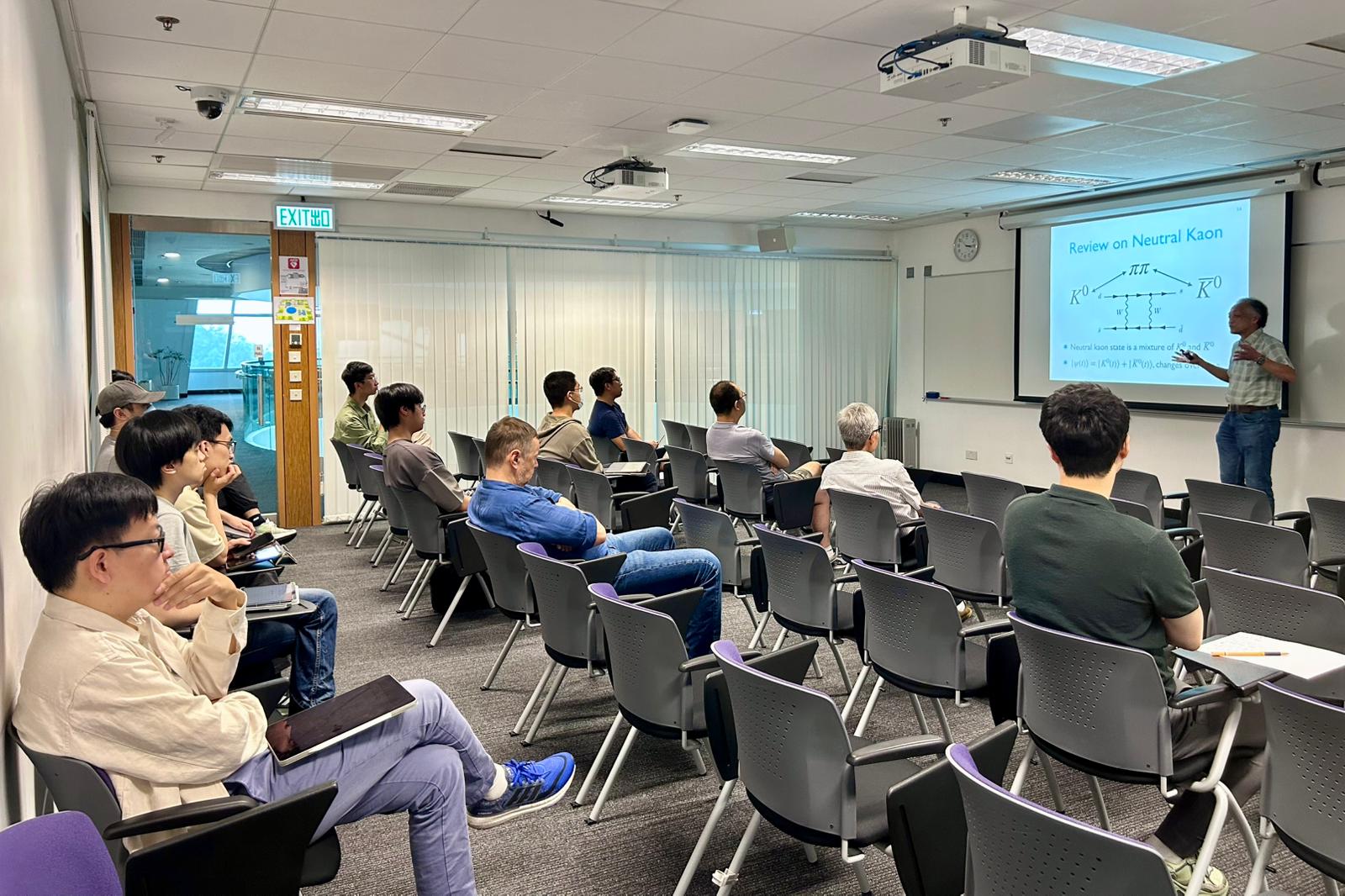
In this seminar, the speaker will review the different experimental approaches that have been developed to search for this decay, discuss how various background sources were identified and mitigated, and present a new experiment proposed for the future.
This talk aims to provide theorists with a behind-the-scenes view of the experimental effort underlying a single-number result, and to share with experimentalists the challenges and excitement of designing and executing a high-sensitivity rare-decay experiment.
About the Speaker
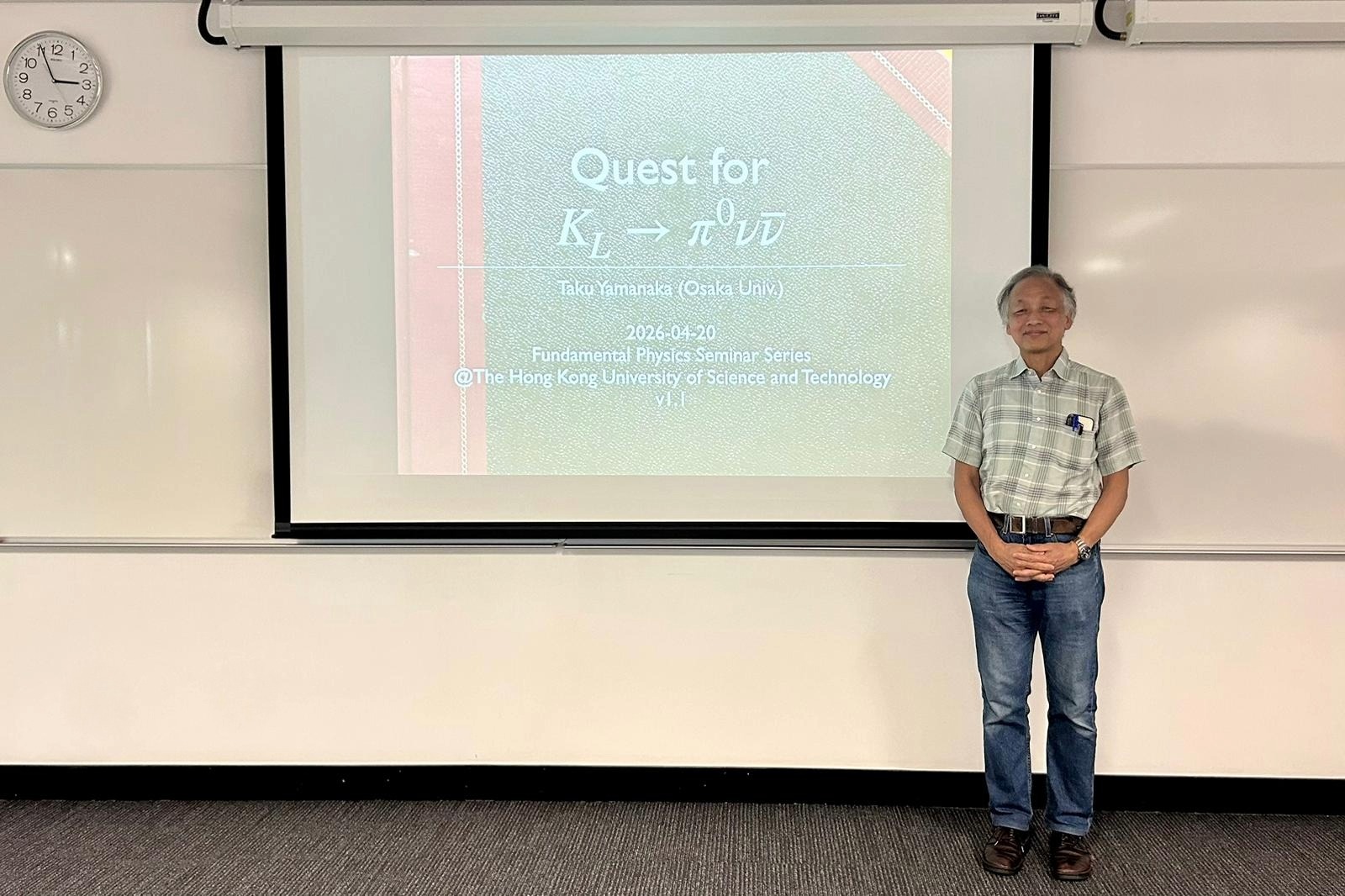
Prof. Taku YAMANAKA is an experimental physicist who has studied CP violation and rare kaon decays. He worked on the Fermilab E731a and KTeV-E832 experiments to measure the CP-violation parameter Re(𝜖′/𝜖) in neutral kaons and demonstrated that CP is violated in the decay process itself, in addition to K0 − K̅0 mixing, thereby supporting the Kobayashi–Maskawa theory.
In 1988, together with Prof. WAH Yau Wai of The University of Chicago, he proposed a new type of experiment to search for rare kaon decays using high-energy (800 GeV) protons, at a time when other experiments employed high-intensity but lower-energy (24–30 GeV) proton beams. The proposed Fermilab E799-I and KTeV-E799-II experiments substantially updated the neutral-kaon section of the Particle Data Group booklet, particularly regarding multi-body decays and decays involving photons in the final state.
The KL→𝜋0ννˉ decay became his primary focus in the latter half of his career. He searched for this decay in E799-II, and joined the KEK E391a experiment dedicated to this mode. In 2006, he proposed a new experiment, KOTO, to utilize the high-intensity proton beam at J-PARC, setting the best upper limit on the branching ratio.
Prof. Yamanaka received his PhD from The University of Tokyo in 1985. He became a Research Associate at Fermilab in 1985 and a Wilson Fellow in 1988. In 1992, he was appointed Associate Professor at Osaka University and was promoted to Professor in 2001. After retiring from the university in 2023, he has been working on the KEK IINAS-NX project to foster the next generation of researchers in accelerator-based science, including particle physics.
About the Center for Fundamental Physics
For more information, please refer to https://cfp.hkust.edu.hk/.
For Attendees' Attention
Seating is on a first come, first served basis.