Halide Perovskites Expanding Frontiers in Photovoltaics and Hard Radiation Sensing




Abstract
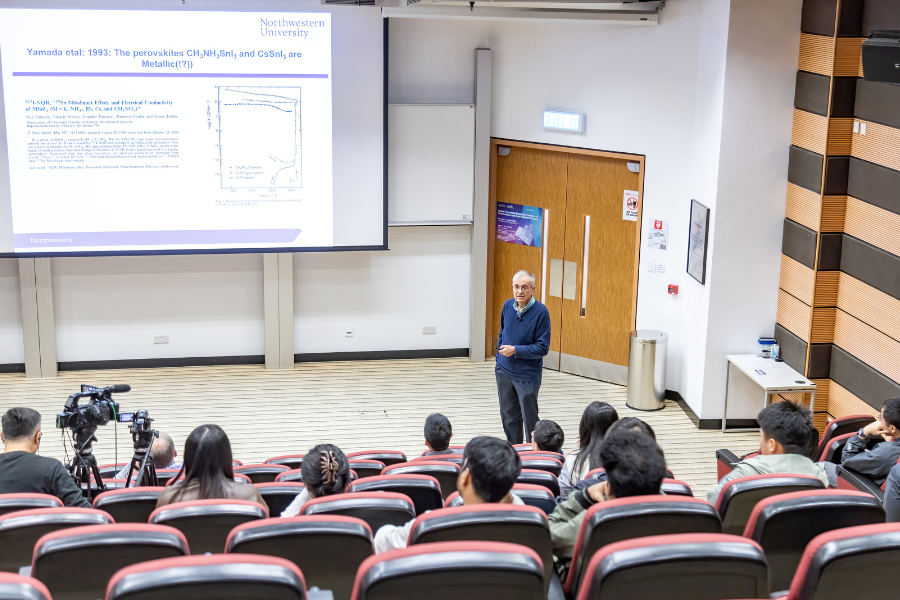
Halide perovskites have transformed how we think about soft, ionic semiconductors in demanding optoelectronic applications. Our early work reported the first solid state solar cell based on a halide perovskite absorber, demonstrating that these materials could function as high performing photovoltaic semiconductors and helping to ignite the modern perovskite solar cell field. Since then, three dimensional and low dimensional halide perovskites and related perovskitoids have emerged as structurally versatile materials with long carrier lifetimes and notable defect tolerance. The speaker will discuss how the stereochemical activity of Pb²⁺ and Sn²⁺, the topology of the metal halide framework, and the choice of organic spacer cations work together to control stability, band structure, and device properties, and how these insights guide rational design of photovoltaic and light emitting materials.
Building on this foundation, the speaker also published the first study revealing the hard x ray and gamma ray detection properties of halide perovskites, specifically CsPbBr3. He will present our recent results on CsPbBr₃ single crystal detectors operating in extreme radiation environments, showing minimal degradation after Mrad level Co 60 exposure and excellent linearity under ultrahigh x ray flux. Polarization effects, deep defect formation, and their mitigation by electric field and trap reduction will be examined, along with comparisons between solution grown and melt grown crystals. Together, these advances show how halide perovskites span a broad frontier from high efficiency solar energy conversion to robust radiation detection.
References:
Chung, I.; Lee, B.; He, J.; Chang, R. P. H.; Kanatzidis, M. G. All-solid-state dye-sensitized solar cells with high efficiency. Nature 2012, 485, 486–489.
Stoumpos, C. C.; Malliakas, C. D.; Peters, J. A.; Liu, Z.; Sebastian, M.; Im, J.; Chasapis, T. C.; Wibowo, A.; Chung, D.-Y.; Freeman, A. J.; Wessels, B. W.; Kanatzidis, M. G. Crystal growth of the perovskite semiconductor CsPbBr₃: A new material for high-energy radiation detection. Cryst. Growth Des. 2013, 13, 2722–2727.
About the Speaker
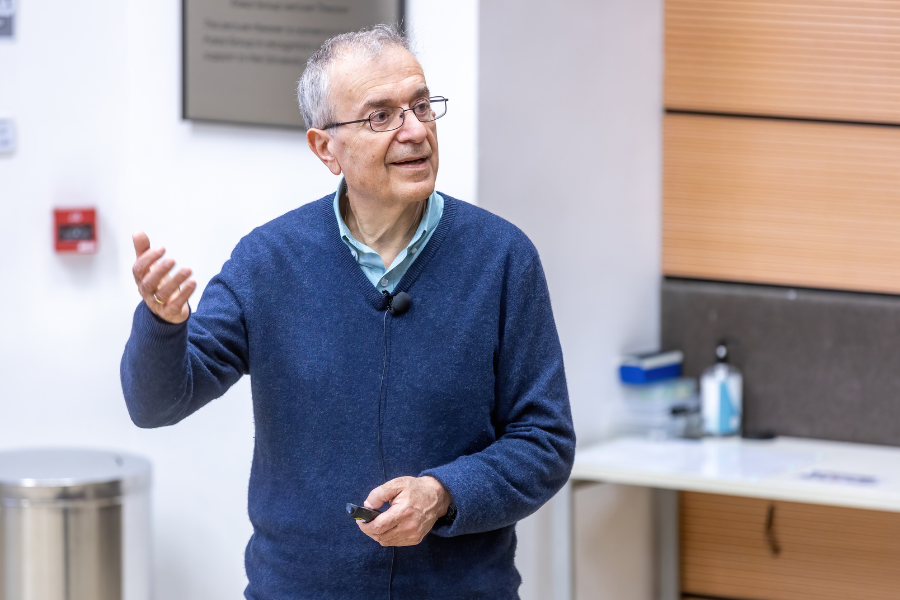
Prof. Mercouri G. KANATZIDIS is a chemist and materials scientist internationally recognized for pioneering work in thermoelectrics, chalcogenide chemistry, and halide perovskite materials for radiation detection and photovoltaics. He earned his BSc from Aristotle University of Thessaloniki and his PhD from the University of Iowa. He is currently a professor at Northwestern University. He published the first report in 2012, demonstrating the use of a halide perovskite semiconductor in a solid-state solar cell device, a landmark achievement that helped launch a new era in photovoltaic research. He later demonstrated that single crystals of CsPbBr₃ function as efficient, high-resolution X-ray and gamma-ray detectors, establishing a new class of solution-processable semiconductors for radiation sensing. Honors include the ACS William H. Nichols Medal, Albert Einstein World Award of Science, ENI Award for Advanced Renewable Energy, the American Chemical Society Award in the Chemistry of Materials, the American Physical Society’s James C. McGroddy Prize for New Materials, the Royal Society of Chemistry’s Centenary Prize, American Association for Crystal Growth Award, and the DOE Ten at Ten Scientific Ideas Award for his seminal contributions to halide perovskites. Kanatzidis was elected to both the American Academy of Arts and Sciences and the US National Academy of Sciences.
For Attendees' Attention
Seating is on a first come, first served basis.